Single-Tooth Implants
An implant-supported crown may be an option for replacing one missing tooth. Assessment helps determine whether this approach is suitable and what treatment stages are needed.
Explore Single-Tooth Implants

DENTAL IMPLANTS
Missing one tooth or exploring options for several missing teeth? Our team can assess your oral health, explain implant and non-implant options, and help you understand the treatment, costs and ongoing care involved.
PATIENT CASES
View two patient cases from Doncaster Hill Dental. Move the slider to compare each patient’s before and after photographs.

 BEFOREAFTER

 BEFOREAFTER
Drag to compare · Use arrows to browse
Keyboard: focus the slider and use ← →
Clinical photographs show treatment performed by Dr Lavonne Kong or her team at Doncaster Hill Dental. Individual results vary. These examples do not predict your outcome; suitability, risks and expected results require an individual assessment.
A PLACE TO START
Implants can support different types of replacement teeth. The appropriate option depends on what needs replacing, your oral health and your individual treatment plan.
An implant-supported crown may be an option for replacing one missing tooth. Assessment helps determine whether this approach is suitable and what treatment stages are needed.
Explore Single-Tooth ImplantsWhen several teeth are missing, implant-supported crowns or a bridge may be considered. The number and position of implants depend on the planned restoration and clinical assessment.
Explore Multiple-Tooth ReplacementAll-on-X uses several implants to support a fixed bridge replacing a full upper or lower set of teeth. The bridge is not routinely removed by the patient.
Explore All-on-X Dental ImplantsA removable denture connects to dental implants for retention. You take it out for cleaning, making it different from a fixed implant bridge.
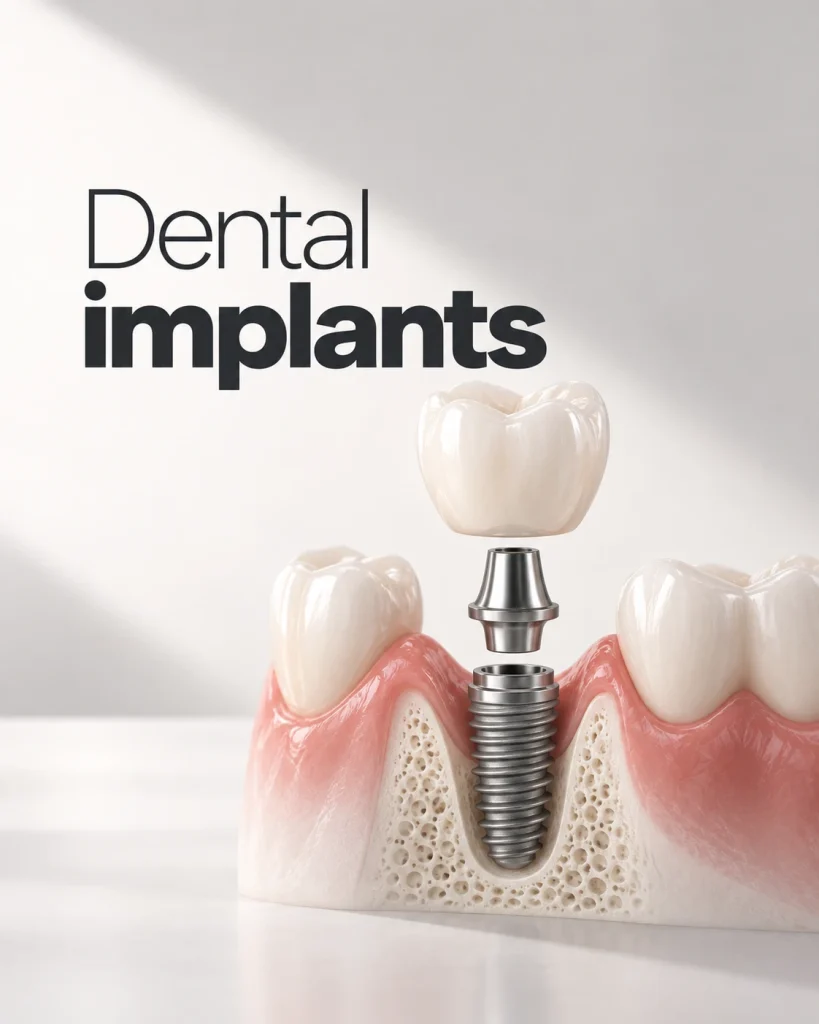
Explore Snap-On DenturesA dental implant is a post placed in the jawbone to support replacement teeth. The implant itself is not the whole replacement tooth: a crown, bridge or denture is attached through connecting components. Different restorations involve different treatment and care needs.
ONE MISSING TOOTH
An implant-supported crown replaces an individual missing tooth. Planning considers the space, neighbouring teeth, gum line and bite, as well as the bone available to support the implant.
The part placed in the jaw, usually made from titanium, which supports the replacement.
The connector between the implant and the visible crown.
The visible replacement tooth, planned for its shape, colour, bite and ease of cleaning.
Your dentist assesses whether an implant is suitable and whether the gum or bone needs preparation. If a damaged tooth remains, the discussion should include whether it can be restored and maintained.
The final crown is planned in relation to nearby teeth and how your teeth meet. Its appearance and function have individual limitations; it is not identical to a natural tooth.
Implant placement and fitting a replacement tooth are separate decisions. Immediate placement, immediate use of the implant and a particular temporary-tooth option cannot be promised before assessment.
SEVERAL MISSING TEETH
The position and pattern of missing teeth affect the designs available. Separate spaces and a group of adjacent missing teeth may call for different approaches.
Separate crowns can be supported by implants where the spaces and clinical conditions allow. Each restoration is planned in relation to the surrounding teeth and bite.
A bridge joins replacement teeth together and is supported by implants. It may replace several teeth without an implant for every missing tooth. Implant positions and numbers follow the restoration plan and assessment.
If you are considering replacement of a full upper or lower set of teeth, explore our All-on-X dental implants and removable snap-on dentures information. Our fixed and removable implant comparison guide explains their everyday differences.
Suitability requires an individual dental assessment. Age alone does not determine whether implant treatment is appropriate.
Your dentist considers the remaining teeth and whether they can be retained, gum health, available bone, medical history and medicines, healing considerations and smoking. Your ability to clean and maintain the restoration, and your expectations, also matter.
Some people need preparatory treatment or grafting; others do not. Ask which investigations are needed, where each stage will take place and whether another clinician or referral may be involved.
Keeping and restoring a suitable existing tooth should be considered before extraction. Depending on your needs, alternatives may include a conventional dental bridge, a removable denture or another individually assessed approach.
Discuss the benefits, limitations, care and costs of each reasonable option. A consultation gives you time to understand the choices before deciding whether to proceed.
These are treatment stages, not a fixed number of appointments. Your written plan should explain the sequence, expected timing and who will provide each stage.
Discuss your concerns, oral health, medical history and possible implant and non-implant approaches.
Appropriate imaging and records help plan the implant position and the replacement tooth or teeth.
Gum treatment, removal of teeth that cannot be retained, grafting or other preparation may be considered.
The implant is placed according to the treatment plan. Anaesthesia, aftercare and individual risks are discussed beforehand.
Healing is monitored. Any temporary replacement and its use are planned for your circumstances.
The crown, bridge or denture is made, fitted and checked when appropriate for your plan and healing.
Daily cleaning, professional reviews and any adjustments or repairs help maintain the restoration and supporting tissues.
Timing varies with healing, preparation and the restoration. Implant placement is not necessarily the same day as fitting the final replacement tooth. Ask what you may wear during treatment and how the plan could change if healing takes longer.
Implant-supported teeth may improve chewing and appearance and provide support or retention for replacement teeth. The likely benefits depend on your starting situation and restoration.
Discuss realistic expectations for eating, speaking and appearance. Implants do not reproduce every feature of natural teeth and are not maintenance-free.
Your dentist should explain your individual risks, recovery and what further treatment or costs could be involved.
The implant in the jaw and the crown, bridge or denture it supports are separate components. Their maintenance, repair and replacement needs can differ. Daily cleaning around the implant and restoration, together with professional review, remains important.
Follow the cleaning and aftercare advice for your own restoration. Reviews are tailored to your needs. Contact the practice if an implant or replacement tooth feels loose, painful or develops swelling. Future adjustments, maintenance and repairs may carry additional costs.
Ask for an individual written quotation before deciding. The price for placing a surgical implant is not necessarily the complete cost of a replacement tooth.
Confirm what is included, what is excluded and what could change the total. Ask about the consultation fee and whether imaging or other investigations are charged separately when you book.
For full-arch treatment, see the cost information on our All-on-X page or snap-on dentures page.
Our payment plans information explains available options and conditions. Confirm any private health insurance benefits with your insurer.

MEET YOUR DENTIST
Dr Lavonne Kong is the founder and principal dentist at Doncaster Hill Dental. Her interests include restorative dentistry, and she has undertaken postgraduate education in implant dentistry.
Let our team know if you would like to discuss your options with Dr Lavonne. Ask who will provide each stage of your implant care and whether other clinicians or referrals may be involved.
Meet Dr Lavonne KongOnline booking opens the practice’s general appointment system. Please tell the team your preferred clinician when arranging your visit.
Yes, an implant-supported crown may replace one missing tooth. Assessment determines whether the space, bone, gums and overall health make this appropriate.
Not necessarily. An implant-supported bridge can replace several teeth. The number and position of implants depend on the planned restoration and clinical assessment.
An All-on-X bridge is fixed for daily use. Snap-on dentures connect to implants but are removed by the patient for cleaning. Their handling and maintenance differ.
Timing varies with preparation, healing and the replacement teeth being made. Ask for an individual sequence and estimated timing; placing an implant does not mean final teeth will be fitted that day.
Some people need grafting or other preparation, and others do not. Your dentist assesses the available bone and proposed implant position before discussing whether grafting is relevant.
A temporary replacement may be considered, depending on the site and treatment plan. Ask what is suitable and what limitations apply. A particular temporary option cannot be guaranteed before assessment.
Check assessment and imaging, placement, the abutment and final restoration, temporary teeth if applicable, any preparation, follow-up and ongoing care. Ask which items are separate fees.
Clean daily using the methods recommended for your restoration and attend individualised professional reviews. The implant, connecting components and replacement teeth may need different care and repairs over time.


